SMART Bansho!
  • Home
  • About
  • Vera's Blog
  • Resources
  • Lessons
    • Oral Language Lessons
    • Math Lessons >
      • Patterning & Algebra
      • Number Sense
      • Data Management & Probability
      • Geometry & Spatial Sense
      • Measurement
  • Contact
  • Take Our Poll!

Summative Report

6/18/2013

0 Comments

 
At this point in the project, participants have to submit a final report to the ministry, reporting on learning, sharing and professional leadership development.  Any outstanding questions may also be shared at this time.  This morning, Dale and I met for the second time to craft our final report.  I am pleased to say it is now complete, and has been submitted to the good folks at the TLLP.

In some sense, this marks the "end" of our project.  There is still a learning summit, which Dale will attend in November (and I possibly via Skype, since I'll be in Argentina at that time!) to share our learning with, and to learn from, other TLLP participants.  But this form summarizes our experiences with the project, and serves as a wrap up for ourselves, as we consider next steps in our own learning.

New Professional Leadership Skills

It's been really mind opening to be able to spend time digging into both the math itself and the pedagogy of how best to teach it to our Grade 3s this year.  I've also enjoyed being able to share our professional learning with others, as we learn from them as well.  As a former program resource consultant with my Board, as well as a pre-service teacher educator at the university level and a workshop facilitator with my teacher federation, I've already had many opportunities to share in large group settings.  But it was the small group learning and mentoring that I most enjoyed this year.  Working with Dale helped me to develop my inner introvert, and visiting other classrooms forced me to reflect on my own practice.  I was also able to develop my individual mentoring skills in ways that I haven't had a chance to previously:  Mentoring colleagues who are further along than the newer teachers or teacher candidates I am used to working with has offered a new challenge, one which I've enjoyed tremendously.

I've also had the opportunity to network with colleagues from other school boards, many of whom have technology skills that far exceed my own.  Learning from them has kept me on my toes this year!

Still Wondering...


Outstanding questions that we listed at the end of our report include the following:
  • How can we increase direct student use of the IWB as a learning tool?
  • How do we engage ALL students in rich, mathematical discussions, to facilitate collaborative inquiry?
  • What are some ways we as teachers can increase our fluency in asking rich questions "on the fly" during a lesson, to stretch student thinking?
  • What does effective scaffolding for vocabulary development look like, on a practical level, in a high ELL school and/or classroom?
  • How do we effectively and realistically remediate basic skills in classrooms?  (Is this better done as an "extra" or "separate" group, or through the problem-based teaching and learning, and if the latter, how?)

An additional question that has been emerging for me in recent weeks is the one about social justice, and how to teach issues of social justice through math, without doing a dis-service to the math itself.

Our full report is below, in PDF, for anyone interested.
participantfinalreportsmartbanshojune2013savebutton.pdf
File Size: 107 kb
File Type: pdf
Download File

0 Comments

Social Justice in the Math Classroom

6/9/2013

0 Comments

 
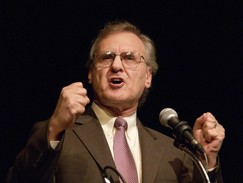
Stephen Lewis
At the beginning of May, Dale and I were very fortunate to attend OAME 2013.  In addition to sharing our own learning vis-a-vis "Smart Bansho" as part of our project goals, we got to attend several sessions of interest.

A key theme of this year’s conference was “Social Justice in the Math Classroom”. 

With Stephen Lewis as the keynote to kick off the conference on the first morning, it was not an easy theme to ignore!

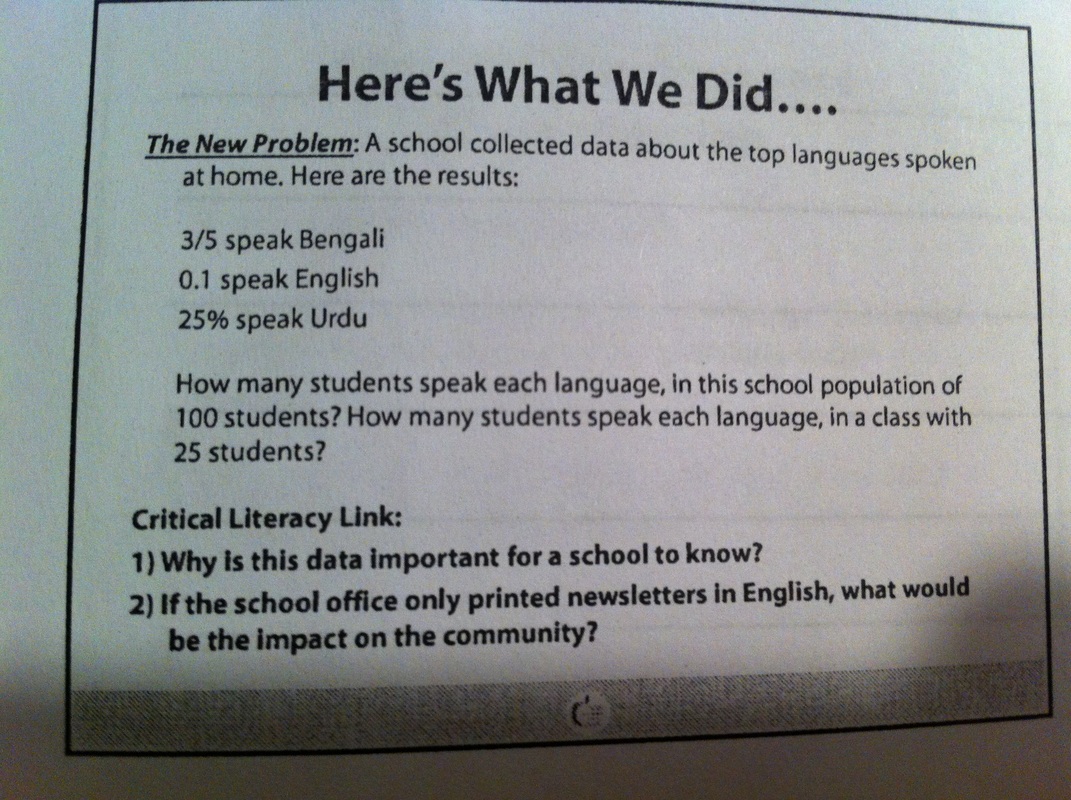
One of the sessions I attended dealt specifically with Social Justice in the Math Classroom.  The session was presented by a team of teachers and resource staff from the Toronto District School Board “Model Schools for Inner Cities” program.  As teachers who want to foster critical literacy in students, they challenged us to consider how each of the “isms” might be addressed in a math classroom to challenge social norms. 

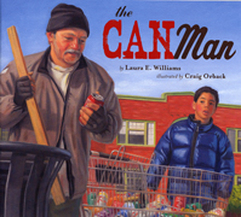
can man book
We thought about this within the framework of the four quadrants:

  • Social Justice as Charity
  • Teaching and Learning About Social Justice
  • Teaching and Learning For Social Justice
  • Teaching and Learning AS Social Justice

As teachers considering how to integrate social justice into our math programs, a question we can ask ourselves is this:  “How can numbers be used to change the world and make it a better place?” 

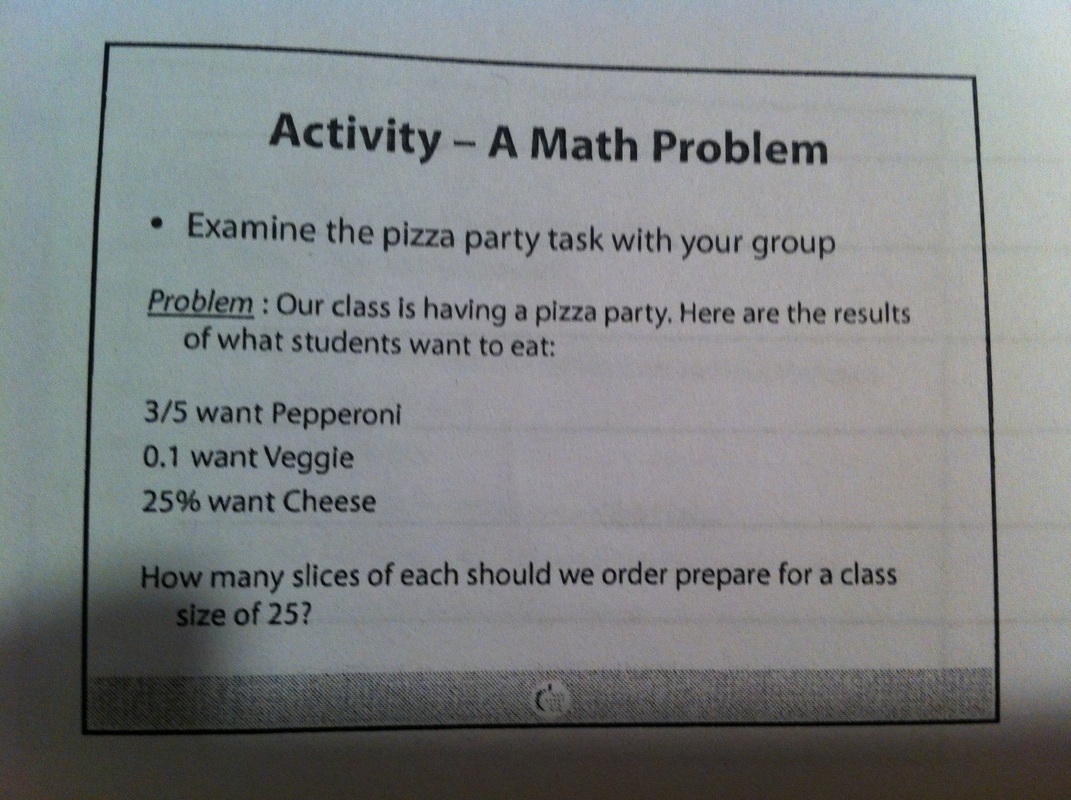
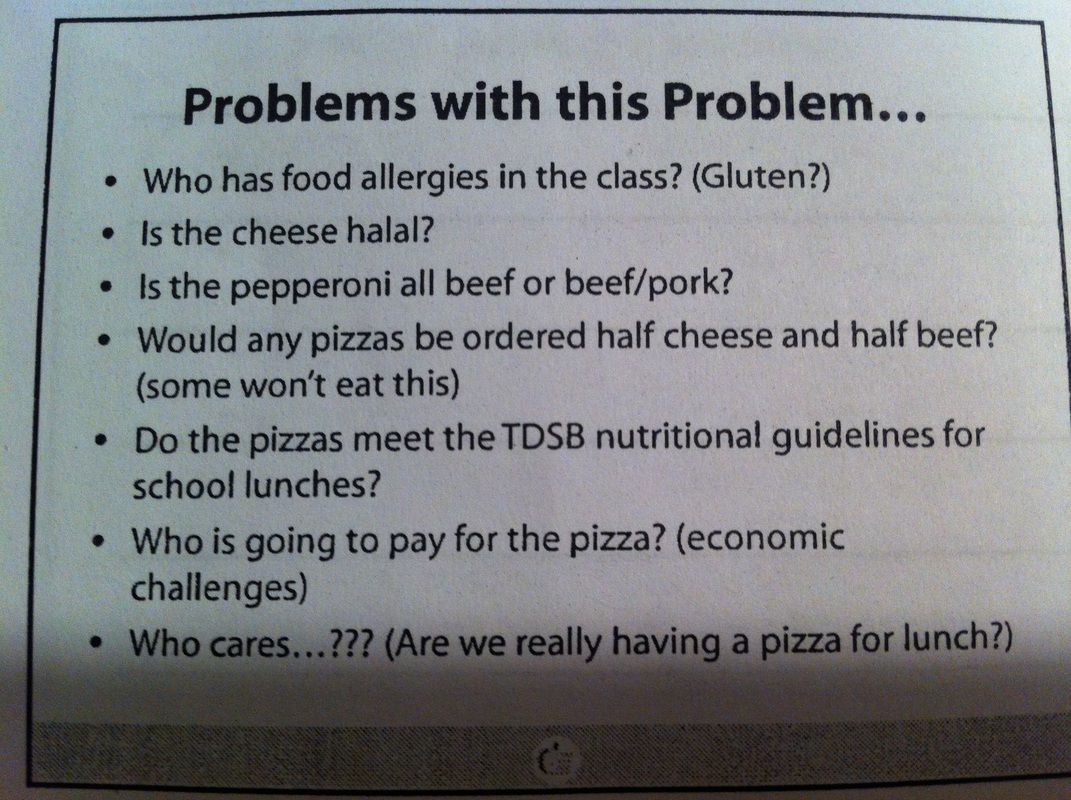
Some examples were given, including the use of picture books (such as the Can Man, by Laura Williams), of how traditional “pizza party” style questions could be turned into  culturally and socially relevant problems that still address the mathematical concepts, but have “value added” in the sense that they address real issues in our world.  Instead of favourite pets, classes could examine immigration statistics and data about LGBTQ bullying.

Something Dale and I have been struggling with is what to focus student attention on. 

You see, I have always been a bit proponent of the “hidden curriculum”, that is, teaching subtly about one thing while seeming to address something else.  (One example is when I was teaching media a few years ago… we were working on examining and creating posters with a specific message.  I wanted students to examine the different features--heading, visuals, captions--within various posters, and then make their own. But I purposely selected posters about people like Rosa Parks because I wanted the students of colour in my classroom to see themselves represented in the material of the curriculum, and I wanted all students to see examples of strong, powerful women.)  But we are also increasingly aware that what the students pay attention to and therefore think about is what they are learning.  The research confirms this!!  (See Willingham's cognitive principles, for example.)

So, do I want students to be thinking about equity issues?  Absolutely.  But I also want and need them to learn how to multiply, measure and construct two- and three-dimensional figures!  These very specific math goals are even more important at the primary level, where students may not have already developed some foundational skills they can draw on during a "bigger" lesson problem.

The question is, when students are engaged with rich, big topics like racism, sexism, poverty and homophobia, are they distracted from the more overt curriculum goals?  Moreover, if we focus on familiar tools or topics to teach difficult mathematical concepts, are the students any more likely to learn said concepts, and if so, then when DO we teach through Equity and Social Justice?!

The OAME workshop didn’t answer these questions, and although I was excited to walk away with some concrete new classroom ideas, I continue to wrestle with these philosophical quandaries. 

0 Comments

2-Step Problems and Vocabulary Troubles

6/3/2013

0 Comments

 
writing EQAO
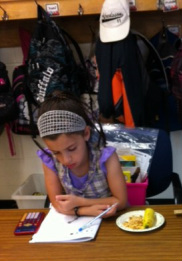
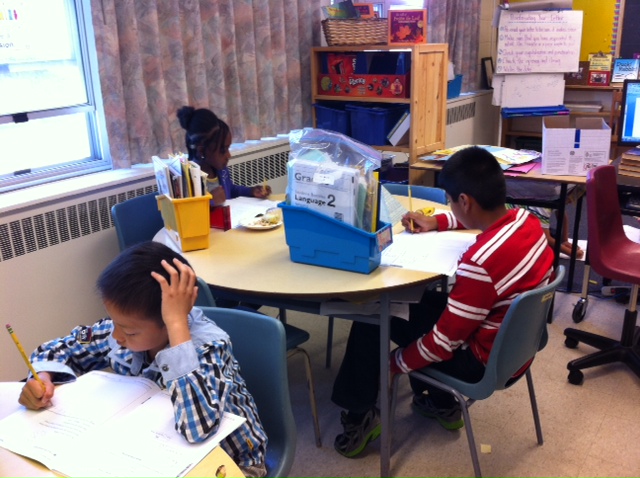
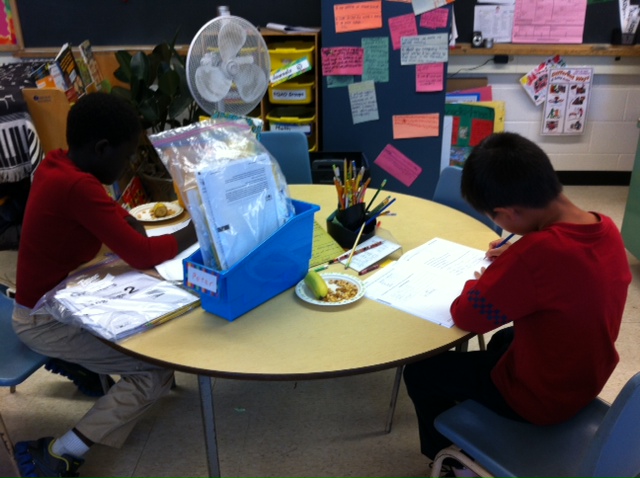
We watched with keen interest as our students worked busily through the EQAO math booklets this year.  Has our “new” instructional practice (Smart Boards and Problem-Based Learning) made a difference in how the students are able to attack a test question?  Will they be able to show their thinking effectively?

This morning we are completing Part 2 of the math booklet.  As in Part 1, students are asked to complete various multiple choice and open response questions spanning all five strands of math.

As they cram the teacher-provided cheerios and bananas into their mouths and scratch with their pencils furiously on the paper, it is evident that they are considerably more confident... as I write this, one student just came up to me and demanded, “Ms., I need a spinner!” and several others are helping themselves to the various manipulatives they think they require, as opposed to waiting for a teacher to tell them what they need.

On the other hand, I am trying not to cringe visibly as I glance at some of their responses – so clearly confused – when we just did this during a recent math class!!!

Analyzing last week’s observations and this morning's, it seems that two things are tripping the students up...

The first is vocabulary.  Although we worked on this extensively, there is a LOT to know, in terms of the academic vocabulary, especially for the average English Language Learner.  Accessing the unit-specific words posted on a chart in the classroom to describe what you are doing during a math lesson in context is a completely different thing than having to recall them from memory while working independently in a high-stakes situation.  Many of the students who asked for help were struggling because they simply did not remember what a word meant, or could not recall the necessary word to explain their thinking.  Or in some cases, they misinterpreted a key piece of vocabulary, which then led them astray for the rest of the question!

The second problem seems to be the two-step problem typical of EQAO open response questions... while I drilled this format into my students for the reading style questions, we really didn’t focus on deconstructing math questions to the same extent, since I wanted to facilitate them in uncovering specific concepts in each strand of  math this year, and learning to effectively communicate their understanding of said concept.  In so doing, I perhaps did not equip them so well with the ability to determine what exactly is being asked of them in a typical two-step problem on this test.

I am curious to see if the pros outweigh the cons when it comes to the students’ results overall on the provincial assessment.  Pity we have to wait until August for that data!
0 Comments

Student Math Games

5/30/2013

1 Comment

 
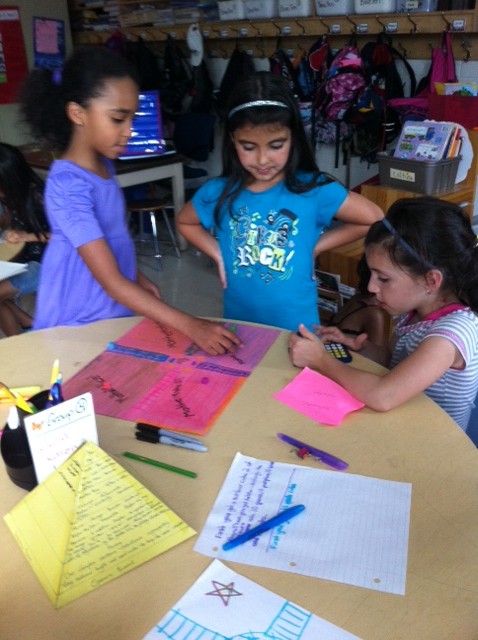
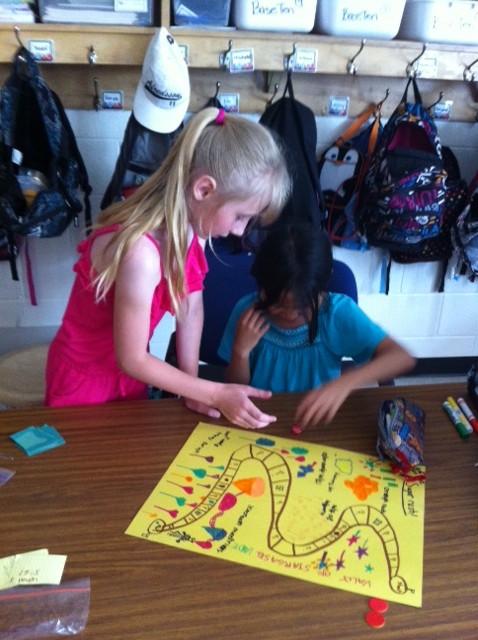
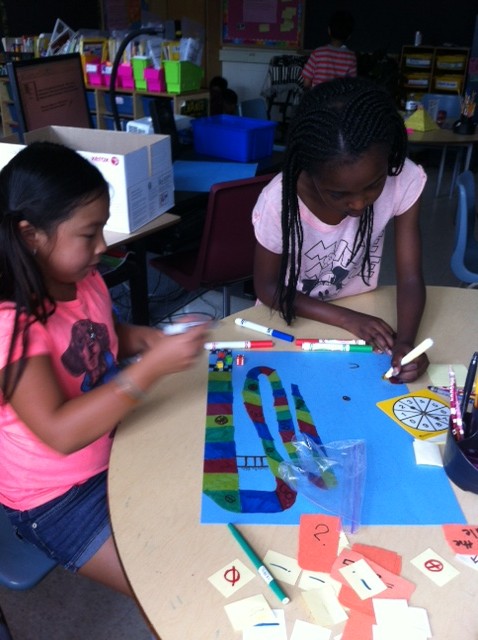
If I were a good teacher, I'd have co-constructed criteria with them, and had them play their games and then measure the success of their games against said criteria.  Or, I could have tied in my persuasive literacy unit and had them write advertisements trying to convince others to play their games.  Or I could have assessed their rules for the game and used it as a mark for procedural writing.

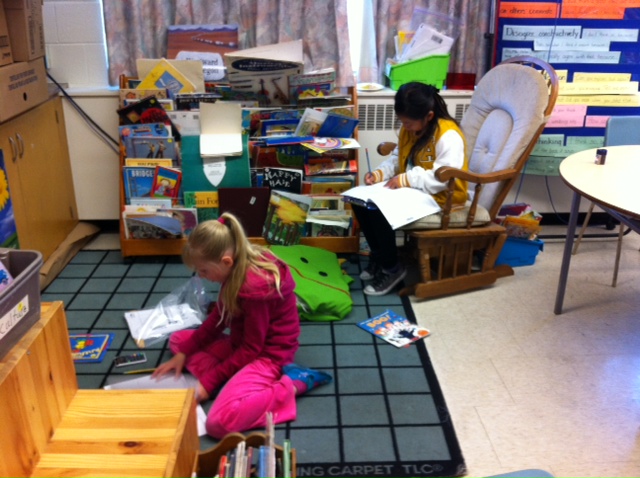
But it's baking in my classroom facing the hot, hot sun, and I'm tired!  So, for today's blog post, I will let the pictures do the talking...
1 Comment

Assessment Templates

5/23/2013

0 Comments

 
Today I rec'd a comment from a reader asking about the assessment template for an oral interview in Geometry which I had blogged about a few weeks ago.  She wondered if I could share a copy to use as a base from which to build her own template.

Here it is below (on the left).  I've also included another, more generic, class list for math (on the right) -- this one happens to be for the Measurement strand. 

I should mention that I am not in favour of reporting on discrete strands in math, because over the year I have come more and more to believe that the skills developed in one strand of math are interconnected with other strands.  A good, rich problem may require the use of tools and skills from a variety of strands.  However, our current reporting reality in Ontario predicates reporting a mark in each isolated strand of math, so I offer this template below (on the right) as one possible option:  Three spots per student are included for "marked" or graded assignments; in addition, there is space for anecdotal comments to be made over the course of a unit.  Once the overall data is considered, and a "final" mark for the unit is arrived at, it can be recorded in the space to the left of each student's name.  These marks can then be quickly entered into report cards
class_list_template_gss_oral_communication.doc
File Size: 64 kb
File Type: doc
Download File

class_list_template_meas.doc
File Size: 60 kb
File Type: doc
Download File

0 Comments

End-of-Year Summary

5/21/2013

0 Comments

 
Picture
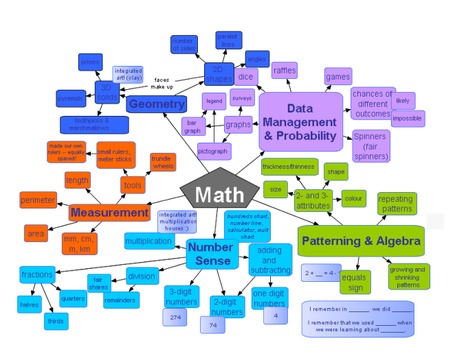
As we prepare for EQAO next week, we took the opportunity to collectively brainstorm everything we remembered learning about in math this year.  I recorded the students' work using Smart Ideas, then I had each student think about something they are pretty comfortable with, as well as 2-3 questions they still have about specific math topics.
Picture
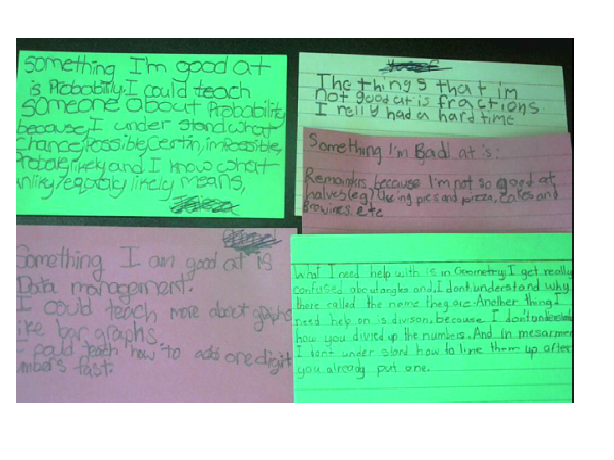
Students wrote their questions and concerns on index cards, which I collected and grouped for tomorrow's math class.  Based on this self-assessment, my support teacher and I will work with small groups and individuals to do a bit of specific remediation on the topics which student self-identified as still tricky.  In some cases, students will be partnered with other students who indicated their comfort with and willingness to tutor a specific concept.

I am also planning to dig up an extension activity for the 4 students in my class who are very confident overall in math; I had them share what they wanted to learn more about, and will follow up with that later this week for those students.

Once EQAO is done, students will work with a partner or in a small group to create a "math game", addressing at least two strands of math, to teach Grade 2 students for next year.
0 Comments

Goals: Explicit or Explored?

5/17/2013

0 Comments

 
Something that came up at the OAME conference we recently attended was the idea of learning goals:  Should they be clearly stated at the beginning of a lesson for students, or not? 

Dale blogged about this very topic recently, after reading John Hattie's "Visible Learning for Teachers".  The research seems to indicate that when students know where they're going, they are more likely to get there.  It kind of makes sense:  The video games our children so often play always begin with a goal or a "mission", so why not our math lessons?

On the other hand, the goals of a lesson can be manifold:  A recent lesson on probability I taught to my grade 3 students focused on the vocabulary of the new concepts we were learning: certain, possible, impossible, likely, unlikely, equal chance and so on...  So, one goal was to learn and correctly use these new words.  But another goal was communication.  I wanted students to communicate their solutions effectively, using a sentence to share their "answer" to a problem I had presented, and to include some sort of explanation (diagram or illustration, math term, or more words) to tell how they arrived at said answer.  A third goal was reasoning.  We've been working on asking ourselves, before we present solutions to a problem, "is this a reasonable answer? How do I know?"  Finally, since students were working with a partner to discuss this particular problem, we were focusing on collaboration for learning skills; I was observing how well they listened and shared with one another during the work period, so that I could collect some data for report cards.

Am I to share ALL of these goals with my students?  And if so, when?

After fiddling around with some different models, I have found it effective to highlight the mathematical goals of a lesson or unit early in the lesson, right after the "minds on", and before presenting the actual problem that students will work on.  An addition, I will often draw students' attention to the criteria which we co-constructed earlier in the year, about how to best communicate thinking, which are permanently posted in the room for handy reference.  I do this as they are working, but before they share their solutions.
0 Comments

OAME 2013

5/17/2013

0 Comments

 
Picture
At the beginning of May, Dale and I were lucky enough to attend OAME, an enormous, annual conference for mathematics educators across Ontario.  We had submitted a proposal to present a double session at the conference, sharing our own work, and this allowed us to attend the rest of conference free of charge.  (Release time was provided by the TLLP and our Board’s Program Dept.)

We both attended the keynote on the first day, as well as an “advanced bansho” session on Day 2.  In addition, each of us attended one other session, and spoke with a number of attendees on both days.  Our own session, entitled simply “Smart Bansho”, had about 30 attendees.

A conference of this size tends to surface a number of common themes; it seems that many of the sessions, key notes and casual conversations with colleagues at lunch generate similar “big ideas”.  This year, I came away from the conference thinking about these two things:

1. Social Justice has landed in the math classroom!  The keynote on the first day spoke explicitly about this, several workshops addressed the topic specifically, and many others embedded it or referred it in their sessions. I will blog on social justice in math in a separate post.


2. The math processes and “big ideas” in math are critically important to a cohesive presentation of the math program by teachers; we need to stop focusing so much on individual expectations, and rather consider how we can best weave these together to facilitate our students in developing a sense of the grander scheme of things.  Already some schools and school boards are using the math processes rather than the overall or specific expectations to report on progress in math.  The processes are inter-strand; communication or reasoning do not just live in “Number Sense” or “Geometry” but transcend many or all five strands of math, as do good, rich problems which help students develop these skills. 


interconnectedness
3. Teaching math well takes time.  Well, okay, this was not new learning for me, but rather, a confirmation of reality!  Dale and I spent a double session with colleagues across the province developing and doing ONE math problem.  ONE!  The importance of doing the math in order to anticipate possible student responses was underscored.  Taking the time to think about how the pieces fit together, and how best to present different concepts (and in what order) to students, considering how to integrate issues of social justice and equity meaningfully into ones lessons, make math "real" for students, assessing their work and providing timely, personal, descriptive feedback... it all takes time.  Dale and I really recognized that this year, as we were blessed with so much release time to think about and address some of these things.


The trouble of course is that as the thinkers in the intellectual organizations and the practitioners in the classrooms come to recognize how to do things well, they/we are stifled by archaic institutional structures.  A simple example is the Ontario Report Card.  How, dear readers, am I to realistically track and report a discrete mark for five individual strands of math in a program that effectively integrates across strands and processes?  How do I transform my detailed, individualized observations of each student's strengths and needs into a generic chunk of text that can be plugged into the limited box provided on a report card designed for the masses?!  (I asked one of the presenters at a workshop this question -- her reply was that she "doesn't worry about report cards too much".  Easy for her, I commented to my table group; she hasn't had to write them in almost 20 years!)  When do I get to meet with colleagues down the hall and across the province, on a regular basis, so that effective practices can be meaningfully shared amongst the people who use them daily with real students in real classrooms?!

Although the impossibility of the task at hand can seem overwhelming at times, it is nevertheless exciting to attend a conference like this and take in some of the many tools, resources and ideas that are constantly being developed in mathematical instruction.  I am left with lots to think about.

0 Comments

A Few Words from Ottawa

5/17/2013

0 Comments

 
Thanks, Mr. Surti's Website

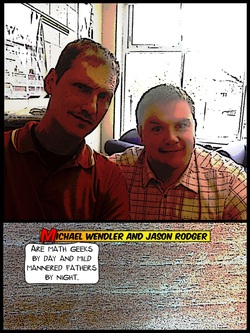
Thanks to additional release time funding from the TLLP, this morning I had the opportunity to interview Michael Wendler and Jason Rodger, two junior teachers from Ottawa-Carlton District School Board who have been early adopters of IWBs in the Math Classroom.

Jason and Michael teach in a fairly large, K-6 school in Ottawa, with a mainly middle-class, culturally diverse population.  Their school has two laptop carts and a class set of iPads which teachers can sign out.  Thanks to the efforts of a small but dedicated group of teachers, several classrooms also have Smart Boards in them now.

After reflecting in some detail about the challenges and opportunities that technology presents to teachers at different places along the continuum of tech-comfort, we spoke about how teachers use technology to integrate social justice into their programs, and make learning “real” for students.  We also addressed student vs. teacher use of the IWB as an instructional/learning tool in the classroom, and the boys shared some of the different apps and programs they have found useful in their journey with students.  It was really encouraging to see two teachers at different stages of SAMR being so comfortable learning from and sharing with one another, and it made me feel more optimistic about my own abilities as a teacher who still uses technology primarily to substitute and augment, rather than to modify and redefine!

After a brief earthquake (no, I’m not kidding; we all felt the tremor, on both sides of the Skype!),  we chatted briefly about some more philosophical things, like how some students with an LD can really focus when it comes to video games, and how we can harness that interest and ability with technology, and we also discussed the more pressing matter of TIME, which seems to be in ever-short supply for teachers across this province.  (How do you build in the time necessary to be a learner of the “new” tools, for example, and develop a basic comfort and confidence with them, so you can use them effectively in your classroom?)

Before we knew it, our time was up, and we were wrapping up our discussions and trying to figure out the logistics of how to get over an hour of Skype footage edited and up onto the Internet so that others could listen in on our conversation.

It was good to hear from two such engaged educators, and see how colleagues from other parts of the province are using technology to develop mathematical understanding with their students.  As Michael noted near the beginning of our Skype session, and Jason concluded towards the end, technology needn’t be overwhelming.  Beginning with one small step can open the door to unlimited possibilities not just for students, but for us, the teachers who teach them.

Thanks, Jason and Michael, for your enthusiasm, and for your willingness to share with this new-to-technology teacher!

(Please stay tuned... video and/or audio footage hopefully coming soon!!!)
0 Comments

What are the Big Ideas Here?

5/15/2013

0 Comments

 
Wordle: Smart Bansho May 2013
The this project's end draws nearer, I've been thinking about what we'll highlight in the report we need to write for the Ministry next month.  How will we synthesize all our learning over the past 14 months into four short pages?!

I immediately thought of Wordle. So, I plugged my blog's feed into the program, and voi-la! (to the left)
0 Comments
<<Previous

    Author

    Vera C. Teschow is a teacher, vegetarian, student pilot, drummer, and mother of monozygotic twin boys. 

    Vera, student pilot, 2011

    Archives

    June 2013
    May 2013
    April 2013
    March 2013
    February 2013
    January 2013
    December 2012
    November 2012
    October 2012
    September 2012
    August 2012
    June 2012
    May 2012
    April 2012


    Categories

    All
    Assessment
    Learning From Colleagues
    Philosophy
    Remediation
    Resources
    Smart Board
    Student Motivation
    Talking About Math
    The Project

    RSS Feed

Powered by Create your own unique website with customizable templates.
Photos from fdecomite, Robert S. Donovan, Brimack